Mark Bridge: not him, the other one
Get social
  • Home
  • Writing
  • Photo and video
  • Music and podcasting
  • Social networking
  • Showcase

Addicted to Bass

1/6/2016

0 Comments

 
Picture
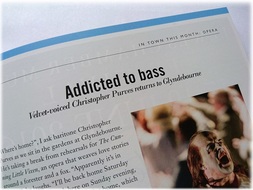
“Where’s home?”, I ask baritone Christopher Purves as we sit in the gardens at Glyndebourne. He’s taking a break from rehearsals for The Cunning Little Vixen, an opera that weaves love stories around a forester and a fox. “Apparently it’s in Oxford”, he laughs. “I’ll be back home Saturday afternoon and then back here on Sunday evening, very late. So I get a day and a half at home, which is not enough but that’s just the way it goes. We’re relatively used to it.” These days Christopher sings his way around the world, staying in temporary accommodation when performing in Europe, the United States and Australia. “When the kids were small I would not go abroad, just because I thought ‘this is ludicrous, not being able to see them at all’. I couldn’t think of a good enough reason to ruin my life so completely.”
 
It’s now 20 years since Christopher first came to Glyndebourne as an understudy before returning to perform in 2007, 2009 and – in a ‘truly fearsome and mesmerising performance’, according to Opera Today – the title role in Handel’s Saul last year. “It’s a wonderful thing to have your so-called art appreciated to such an extent”, he admits. “It was the best fun I’ve ever had.”
 
Christopher Purves has been singing since childhood. “I'm the youngest of four boys in the family. I think I had to fight for attention.” As a youngster, he was a chorister at King’s College, Cambridge. In his 20s, he spent several years as part of doo-wop band Harvey and the Wallbangers before heading into opera. But where does the acting come from? “I’ve got no idea”, he tells me. “If you talk to anyone and ask them what they're doing, they'll try and explain it to you in ways you can understand. I think opera is precisely that. We're given scenarios that are rather weird and we have to explain them. It's an extreme version of talking.”
 
His role as the Forester in The Cunning Little Vixen is “quite a soulful man”, Christopher says. “He's not sad, he's not desperately happy, but he's normal. I think a lot of people can understand where his life is going. It’s very touchingly human.” And the internationally-travelled singer who portrays him is equally down-to-earth. “I love being at home. It's an extraordinary thing but it's true. I can take my dog for a walk, I can cook an evening meal, I can spend time talking to my sons – my daughter is away at the moment – you know, just normal life that people take for granted. For me it's such a blessing. But I still enjoy the buzz; I still enjoy the excitement of starting up a new rehearsal period for a new opera. So, I think while that excitement still exists, I will carry on.”
 
Glyndebourne Festival 2016 runs until late August. The Cunning Little Vixen opens on Sunday 12 June. glyndebourne.com

First published in Viva Lewes magazine issue 117 June 2016
0 Comments

The Encounter: bringing an Amazonian adventure to Falmer

1/5/2016

0 Comments

 
The London-based Complicite touring theatre company launched in 1983 and gained a reputation for producing “the most imaginative theatre to be found anywhere”, according to David Lister of The Independent. This month they’re bringing an already sold-out show called The Encounter to the recently-refurbished Attenborough Centre for the Creative Arts, which is on the University of Sussex campus at Falmer. Now named after the work of Lord (Richard) Attenborough and his family, the building was previously known as the Gardner Arts Centre.
 
Kirsty Housley, who’s co-directing The Encounter, thought she’d only be involved for a few weeks of research when she joined the production team in 2010. “That couple of weeks turned into a few months… and then the project kind-of continued, really”, she tells me. It’s part of the distinctive way Complicite operates. “Each time a project is created, a company is built around that project. There’s a genuine ‘not knowing’ at the beginning of the process. You relinquish an element of control, which is quite scary.” In addition, the work they do is never seen as finished. “You never lock something down and say ‘that’s it, keep it exactly as it is now, repeat what you’re doing’. So there’s always a sense of evolution in the performance as well.”
 
Performing in The Encounter is Complicite co-founder Simon McBurney, who’s known to many as the sinister MI6 man in last year’s Mission: Impossible film and as the often unsympathetic Archbishop Robert in TV sitcom Rev. The story is adapted from a book called Amazon Beaming, which tells the adventures of photojournalist Loren McIntyre. In 1969, McIntyre went looking for the elusive Mayoruna tribe in South America. Also known as the Matsés, they were popularly referred to as 'cat people' because of their facial tattoos and the whisker-like spines they wore in their noses. He found them – but, as he followed a group into the rainforest, he lost track of his original route. McIntyre’s planned three-day trip turned into weeks spent with people who shared no common language with him. Yet much to the photographer’s surprise, he seemed to develop a wordless way of communicating with the tribe’s elderly leader.
 
Which helps to explain why The Encounter doesn’t tell McIntyre’s story with conventional imagery. Simon McBurney performs it as a one-man show, assisted by binaural headsets that blend his performance with sound effects to put the audience in the heart of the jungle. “A lot of the technology had to be custom-built”, says Kirsty Housley. “We create the feeling of being somewhere rather than trying to visually represent what that place looks like. You don’t see any creepers or any green leaves. Like all theatre, it really takes place in your imagination rather than on the stage.” 
 
The Encounter runs from Wednesday 11 until Sunday 15 May 2016. brightonfestival.org

First published in Viva Lewes magazine issue 116 May 2016
0 Comments

William the Conqueror

2/4/2016

0 Comments

 
My phone rings. “Hiya Mark, it’s Ruarri Joseph”. He pronounces his first name to rhyme with ‘brewery’, which deals with my first worry. “How’s it going, man?” Truth is I’m slightly star-struck, with a copy of Ruarri’s 2007 debut CD Tales of Grime and Grit in my collection.
 
That first album prompted many favourable comparisons, although Ruarri is cautious about being pigeonholed. “I think somebody once said ‘Dylan, had he grown up in Newquay’ [that was NME], which you can only take as a compliment, but any Dylan fans are going to give you a listen and go ‘what are you on about?’ Similarly, with Atlantic Records, they tried to sell me as the 'British Jack Johnson', presumably because I live near the beach. But again, no disrespect to Jack Johnson, that's not who I am. You're almost turning people away. If they're going to listen to you because of that, then they're going to be disappointed."
 
After his first CD, Ruarri Joseph decided that a contract with a major record label wasn’t right for him, so he recorded his next album independently. "I read somewhere once that I left Atlantic over a dispute because of creative differences. I think that's the story people have tried to paint. I don't recall that being the way it happened.” In 2009 there was a third studio album and in 2012 a fourth, Brother, which was a tribute to his friend Matt Upsher, who died in a surfing accident. I ask how his songwriting has evolved over the past decade. "I went through a time of being very pragmatic around it, certainly with the last solo record, poring over the lyrics and poring over how it came across. It wasn't an album that was for me; I wanted it to tick the right boxes for everybody that knew Matt."
 
The intensity of Brother, combined with its popularity, led to what was billed as the Ruarri Joseph Farewell Tour last year. “I felt like I needed a break from those songs. I'd sung them so many times over the course of three years and I didn't want them to lose meaning”, he tells me.
 
So Ruarri Joseph the solo artist is gone… and Ruarri Joseph the person has adopted a new identity. It’s William the Conqueror who’s currently touring the UK and will be visiting Union Music Store on Record Store Day this month. But is William the man or the band? "I like the ambiguity", Ruarri/William tells me. "Sometimes it's appropriate for it to be me and sometimes it's appropriate for it to be the band. That's just the way it happened. When I first started performing, I was William because I was doing it on my own, but then other people joined."
 
The name was chosen initially so that Ruarri could perform ‘secret’ gigs of new material whilst also touring under his real name. “William the Conqueror seemed like a name that was pretty far away from Ruarri Joseph and wouldn't raise any suspicions that it was me.” It’s not the kind of name I’d have expected a modest chap like Ruarri Joseph to have chosen, I suggest. "There you go. I was right." Since being chosen, the name has taken on more significance. "I realised that Ruarri Joseph had only been putting albums out since he had become a dad. I thought it would be cool to write about my life before that, about my childhood and growing up. William the Conqueror was the kind of name I probably would have given myself as a kid; that insane confidence that you can do anything, go anywhere, the world is your oyster.”
 
As William the Conqueror, Ruarri Joseph is finding songwriting much easier than he did under his real name. “In becoming William, it was a case of letting go and almost subconsciously writing the songs; having something in your mind and just seeing where the guitar takes you or seeing where the pen takes you.” He’s already written enough material for a trilogy of albums. “Maybe one way of looking at it would be that my eight years of being a solo artist have been like a kind of training or a PhD. I feel like I've found my voice since becoming William. The songwriting process makes much more sense to me now; it's like a faucet that's opened up. The energy that you have when you're young, when you first start, it's certainly something I've enjoyed trying to tap into again."
 
So far William the Conqueror has just released an EP, while the first full-length album is nearly finished. The band currently consists of drummer Harry Harding and bass player Naomi Holmes, who'd been in Ruarri’s backing band. “We have a nice chemistry when we play. I've enjoyed writing with their strengths in mind.” The EP is available digitally, on CD and on a 10-inch vinyl record as well. “I’m very excited about that, not least because my friend Tony Plant has done the artwork. It's a bit of a dream to have it done. That's a really lovely idea, to think that somebody is going to take a physical copy of your record and go to the trouble of putting it on. That's the way it should be. You want people to listen to it properly."
 
What music is on Ruarri’s turntable at the moment? “I got into Tom Waits around the time of CDs, so I have everything on CD but not on record. JJ Cale on vinyl is a winner every time. Bowie's Blackstar hasn't really been off the turntable since I got that. A phenomenal record. I'm a little bit out of touch. Maybe it's because I have the kids kicking around with their things which don't necessarily please my ears, so I retreat into the things I know I'm going to like."
 
Yet despite his striving for the perfectly-crafted song and the perfectly-produced album, Ruarri remains a big fan of live music. “When I started, playing a gig in a pub where I didn't have to do anything other than turn up made it all about the music. There's no better way to figure out whether a song is working. It's like a comedian trying out a joke. Playing live is absolutely essential to figuring out who you are as an artist.”
 
Which brings me back to my question about who ‘William’ actually is. After 45 minutes on the phone I think I have an answer. As far as I can tell, William the Conqueror is the man Ruarri Joseph didn’t get a chance to be. “I kind-of fell into the music thing accidentally. It was this crazy whirlwind thing and I never really found my feet with it all. This time round I feel like I know what I'm doing and what I want. I’m really enjoying it. The gigs feel really fresh. I've kind-of forgotten the Ruarri Joseph songs.”
 
Record Store Day is on Sat 16 April 2016; live performances by visiting artists at Union Music Store start from midday. unionmusicstore.com

This is an extended version of an interview first published in Viva Lewes magazine issue 115 April 2016
 

0 Comments

Elephant Man

1/3/2016

0 Comments

 
Picture
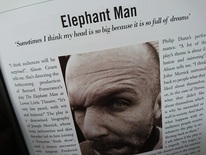
“I think audiences will be surprised”, Alison Grant tells me. She’s directing the forthcoming production of Bernard Pomerance’s play The Elephant Man at Lewes Little Theatre. “It's very fast paced, with wit and humour.” The play is a dramatised biography of Joseph Merrick, whose bone deformities and skin disorder led to him joining a Victorian ‘freak show’, until a chance encounter with surgeon Frederick Treves transformed his life.
 
“What drew me to this play is how people judge and misunderstand”, explains Alison. She first joined Lewes Theatre Club as a teenager in 1967 “to get away from my parents on a Tuesday evening”. Later, whilst living in America, she was responsible for one of the first amateur productions of the play. “Unlike the film with John Hurt, this play is very much about what's going on inside Merrick. Because of his appearance, people expected him to be an imbecile. He was, in fact, very intelligent and sensitive.”
 
The actor playing the Elephant Man – referred to as John Merrick in the play – is Philip Dunn. Opposite him, as Frederick Treves, is Chris Parke. “Treves is almost the main character. His character arc is really rather intense. Then we've got Emily Lassalle, who's playing Mrs Kendall, a high-society actress. She relates to the wounded soul in John Merrick… and he falls in love with her.”
 
Instead of using prosthetics and make-up, the Elephant Man’s appearance is suggested through Philip Dunn’s performance. “A lot of the play’s theme is about illusion and mirroring”, Alison tells me. “I think John Merrick mirrored back to people what they liked about themselves, or, in the case of Treves, what they didn't like about themselves, which is why he succeeded so well in society. And that's what happens with an audience: people receive whatever the play is reflecting back to them."
 
I ask Alison if the play is a tragedy. “It's tragic, in that Merrick’s inner life doesn't match his exterior life. And the other side of the story is the surgeon, Mr Treves. He starts off in control, very sure of himself, but starts to question all his values. So it's a little tragic for him, too.”
 
Behind the production is one further heartbreak that’s not in any script. Last July, Alison’s grandson Tyler died at the age of three, his life shortened by a medical condition that prevented him from moving at all. “He didn’t cry. On the outside he was a perfect child, this little locked-in boy. But we didn’t know what he was thinking. In an age where we're so image-conscious, with people having facial surgery to look 'more perfect', this seemed a good topic to be exploring. And that’s why I particularly wanted to put the play on here, in Lewes, at this time.”
 
Performances Mon 21 to Sat 26 at 7.45pm, plus Saturday matinee 2.45pm. Tickets £10 from 01273 474826 lewestheatre.org
 
First published in Viva Lewes magazine issue 114 March 2016

0 Comments

Playwriting

1/2/2016

0 Comments

 
Picture
Philip Ayckbourn

I've been writing plays ever since I was a youngster. The family name was definitely a weight upon my shoulders, especially going into the same line of work as my father [Sir Alan Ayckbourn]. I went off to catering college to try and be a chef but was drawn back into acting and playwriting. You can't hide from what's really inside you. Since I was young, people have said “are you going to follow in your father's footsteps and be as successful as he is?” I think that's pushed me to find my own way.
 
For 13 years I ran a touring theatre company that travelled around France. In a way, I felt I had to get away from Britain to develop my craft. It was a good place to practise without the comparisons and the obvious associations that people would make if I was doing it in this country.
 
I like to begin writing my plays with a theme or an idea that I want to explore, then I try to link all the elements in the play to that particular theme. And then I tend to play with it in my mind. The story comes out of that, really. It develops organically. Part of the fun is allowing the story to tell itself.
 
Everybody has their own story and their own way of telling their story. A lot of people just say “I can't do it”, so I run playwriting courses to help them. To begin with, we need to deal with our own self-censoring and judgements on what we're writing. After that, you can look at the finer details of shaping the play: motivations, sub-text, structure and story. So I find ways of encouraging people to take little steps and write without thinking about it too much.
 
If you think you've got a play within you but don't know what to do about it, I suggest going to a writing group or to someone who knows about playwriting. Otherwise you can take a very long way round it, hitting your head against a lot of brick walls. That was my path. At first I didn't know how to shape my ideas but I was determined and stubborn. It took me quite a while to realise that a writing group was probably a better way to do it. But you have to find the right people to talk to. If you talk to the wrong person, they'll take your idea and change it by saying "what about this instead?"
 
I moved to Lewes early last year. I’d had enough of London. I wanted to find somewhere that I could connect to. My ideal is to set up a creative hub, where we can learn writing, acting and other aspects of theatre, and then put on productions. That's the dream, really.
 
Philip's ten-week playwriting course starts Mon 1 Feb; details from philipayckbourn.com or [email protected]

First published in Viva Lewes magazine issue 113 February 2016​

0 Comments

Trade Secrets

2/1/2016

0 Comments

 
St Anne's Pharmacy
Debbie Baker
Pharmacist, St Anne's Pharmacy

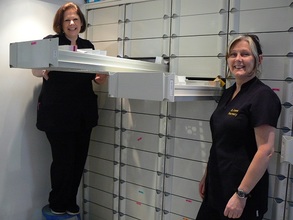
The business is run by me and Karen Smillie. We first worked together at another pharmacy in the town: Karen was the manager and I joined as a technician when I was 16. After several years I left to do my pharmacy degree but eventually we got together again and agreed that Lewes needed another pharmacy, so we put the wheels in motion. We’ve just celebrated our tenth anniversary of being in business.
 
Being an independently-owned pharmacy is unusual these days. There's a huge amount of background work, whereas the multiples have a head office that deals with all the red tape and that sort of thing. But they haven't got the flexibility we have. Most of our business is from prescriptions, not over-the-counter sales. It’s different for the multiples because they have a huge retail side.
 
We buy all the drugs. A lot of people don't realise this. So if you go into a pharmacy with your prescription and they've got your medication on the shelf, it's because they've ordered the products and are hoping someone will need them. We can buy thousands of pounds of drugs but it comes out of our pocket. The NHS will only pay us when we've given a patient the medication that’s listed on their prescription.
 
People tend to contemplate New Year's resolutions in January, so it's a good time of year to think about health: diet, exercise and giving up smoking. It’s relatively quiet for us, although the lead-up to Christmas is absolutely manic. Some people get in a panic about having enough medication because we're closed for four days, which causes a horrendous workload.
 
There's a lot we can do to help people manage their medical conditions. Often your pharmacist can help with extra information about your prescription. We also provide a particular service called a Medicine Use Review, where patients can discuss how they're using their medication and what problems they're having. You can come in and have a completely private consultation with a pharmacist.
 
I wish people would keep their medication in its original packaging. The appearance of tablets and packaging can change, which means people can get muddled up and start taking the wrong amounts. And please don't order things you don't need. The NHS pays for the medicine - and if it's not used, the NHS also pays to have it incinerated.
 
Sometimes I cringe when people come in and say "I've got flu". It's very unlikely you'd be able to walk in if you actually had flu. I'm a big fan of those fizzy vitamin tablets like Berocca if you have a cold or you're surrounded by people who have colds. And Difflam Spray for really sore throats. But ask your pharmacist first!
 
As told to Mark Bridge
 
50 Western Road, Lewes  BN7 1RP  01273 474645
 
First published in Viva Lewes magazine issue 112 January 2016

0 Comments

Design Specific

1/1/2016

0 Comments

 
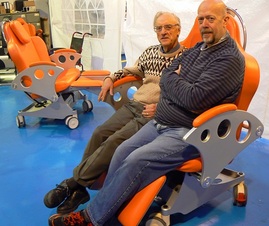
Richard Fletcher and John Walters
On a small industrial estate at the edge of Ringmer is a company that proudly claims to produce the widest range of wheelchair platforms and recliners in the world. For example, they make a portable device that tilts a patient in a wheelchair, enabling that person to receive dental treatment without being transferred onto a dentist’s couch. And there are motorised chairs that’ll adjust to fit bariatric patients weighing over 50 stone, making it easier for medical staff to transfer and treat people on a single piece of equipment. It means undignified and potentially dangerous hoists can be confined to the past.
 
The company was born from a project at the University of Brighton. Richard Fletcher was leading the MSc Product Innovation and Design course when a London hospital asked for help designing a wheelchair recliner platform. Not only did Richard’s solution win an award, it led to the creation of his own business almost 16 years ago. He’s CEO of Design Specific Ltd, working with a dedicated staff of five who cover all technical aspects as well as marketing and support.
 
In its way, Design Specific is a very traditional firm. Every new product starts with a pencil-drawn sketch. Components are ordered from local suppliers where possible, with all assembly – including circuit boards – taking place on site. Yet the results are perfectly suited to 21st-century medicine. Instead of inconvenient cables and noisy motors, there are silky-smooth castors, rechargeable batteries and quiet hydraulic lifts. What’s most notable about the products is how attractive they are. “We like to make things that look good”, Richard explains. “You can have style as well as function.” Meanwhile John Walters, Design and International Marketing Manager, talks about a compliment he was paid at a European trade show. “The Germans said ‘It looks German’. That was high praise, as far as I was concerned.”
 
Last year, Design Specific won the coveted Award for Business Innovation during the Lewes District Business Awards. The company sells its products around the world, so why did it enter a local competition? “I don’t chase awards”, Richard tells us. “It was for everyone here. These guys work hard, they put a lot in. I wanted to give their efforts an airing.”
 
“Some people who look at our chairs wouldn't say that's innovation. I think it's innovation because it's a development of something that's never existed before in that form.”
 
And what’s planned for 2016? Richard points to the motorised ‘fifth wheel’ hidden underneath their latest bariatric conveyance chair. At the moment it’s ordered from Germany but will soon be replaced with a home-grown design. “They use cams; we'll be using linear drives. We’ve done a lot of sketches.”
 
Design Specific, Caburn Enterprise Park, The Broyle, Ringmer BN8 5NP
01273 813904

 
First published in Viva Lewes magazine issue 112 January 2016


0 Comments

A new life for the Phoenix

16/12/2015

 
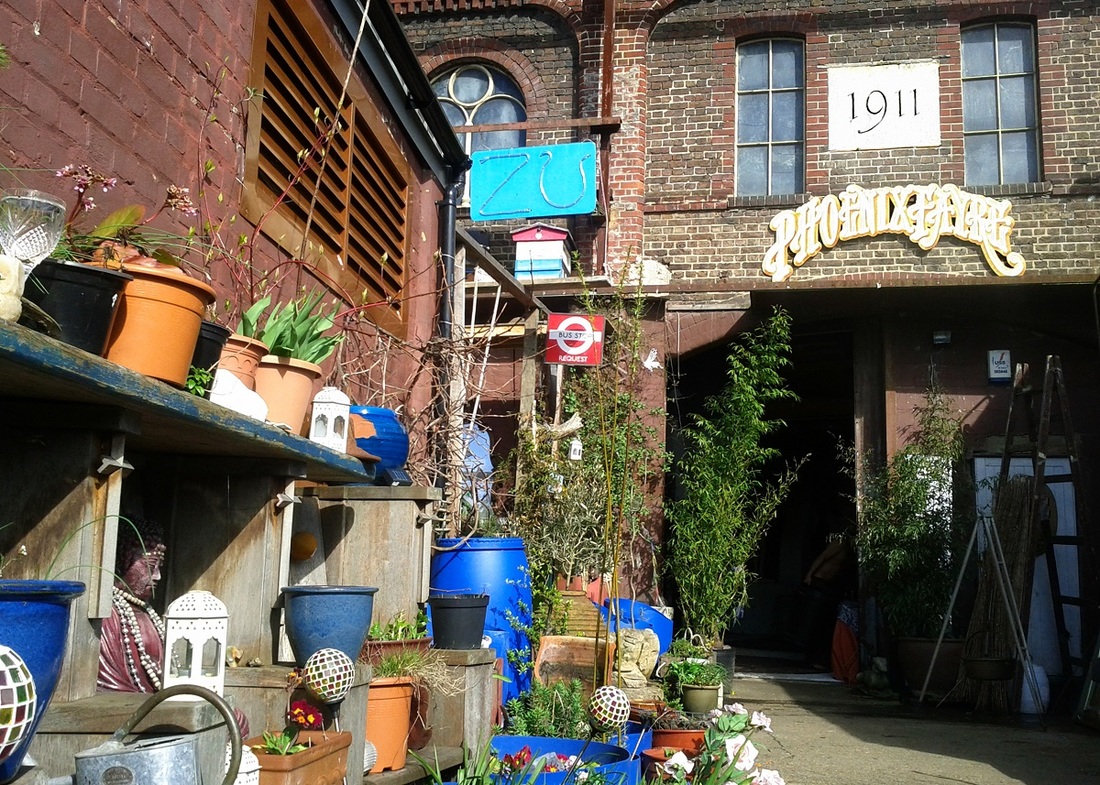
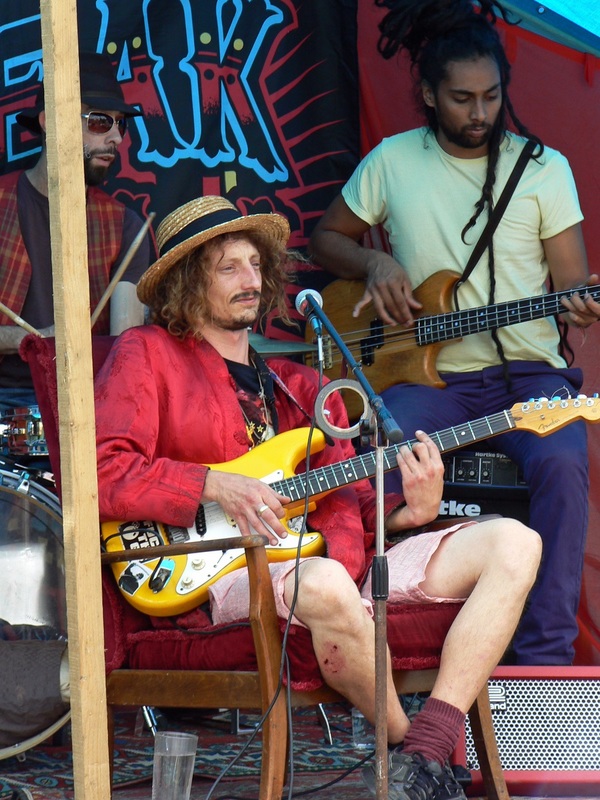
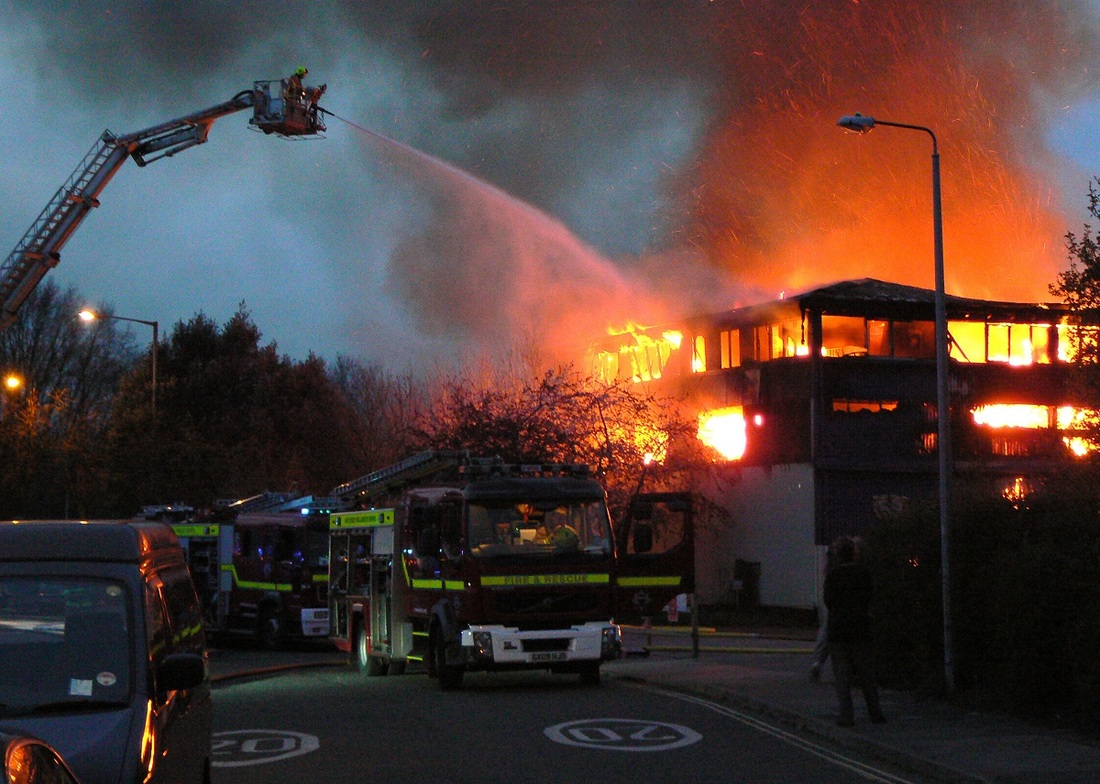
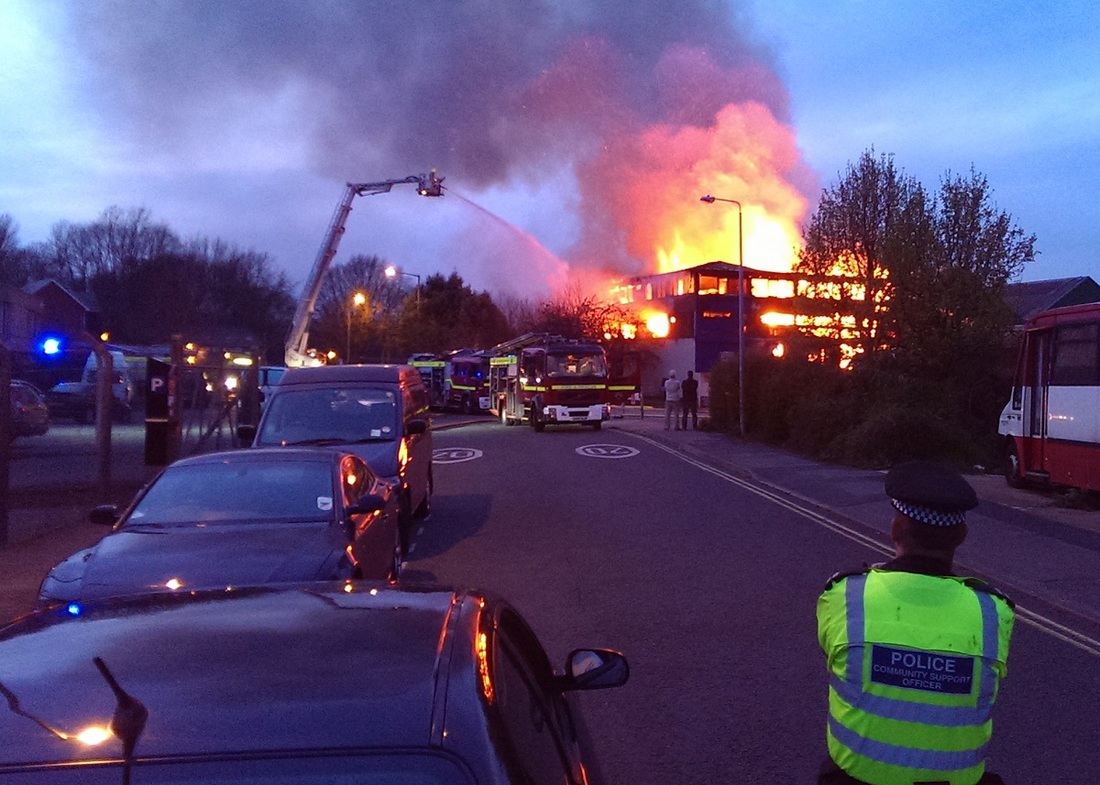
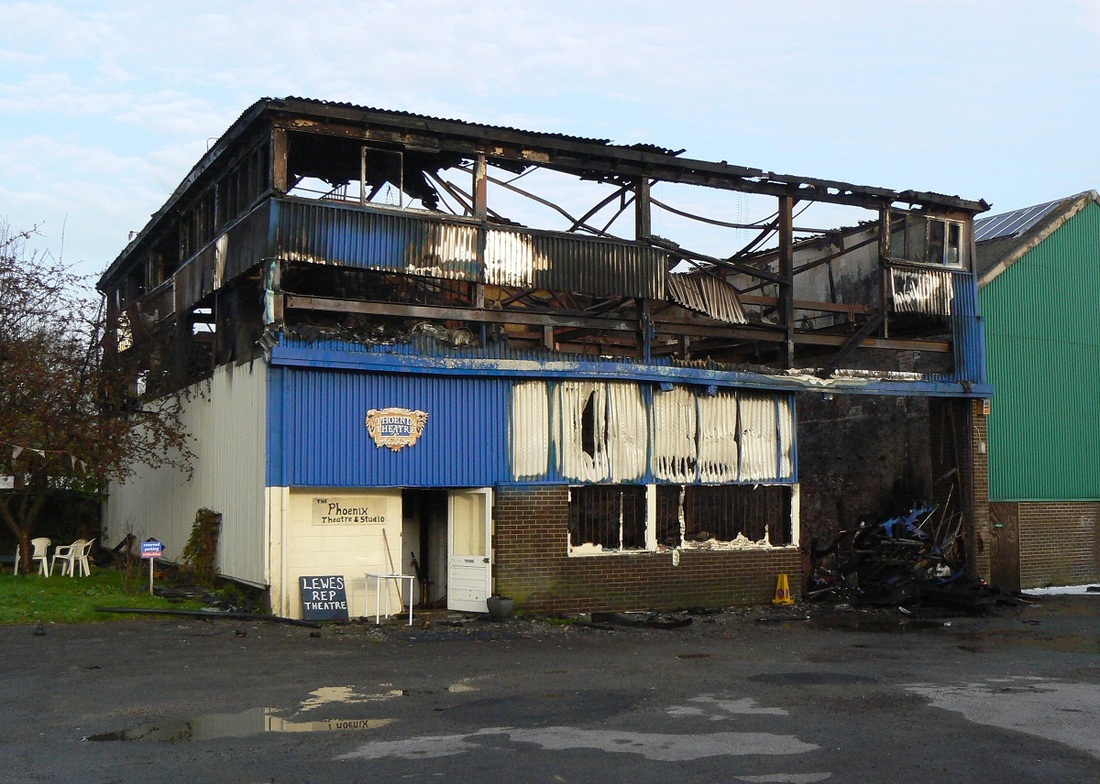
I first became aware of the Lewes North Street 'Phoenix' estate as an entertainment venue. As a collection of venues, really. Music, films, performance, street food... there seemed to be a lot going on. Then, one Saturday evening at the end of March 2014, I knew it as the site of a fire that destroyed the Phoenix Theatre and its associated studios. A local newspaper phoned me on Sunday morning to see if I'd give them one of my photos of the blaze. "Give?", I asked. "Not even a tenner?" And that's why my photo didn't end up in print.
 
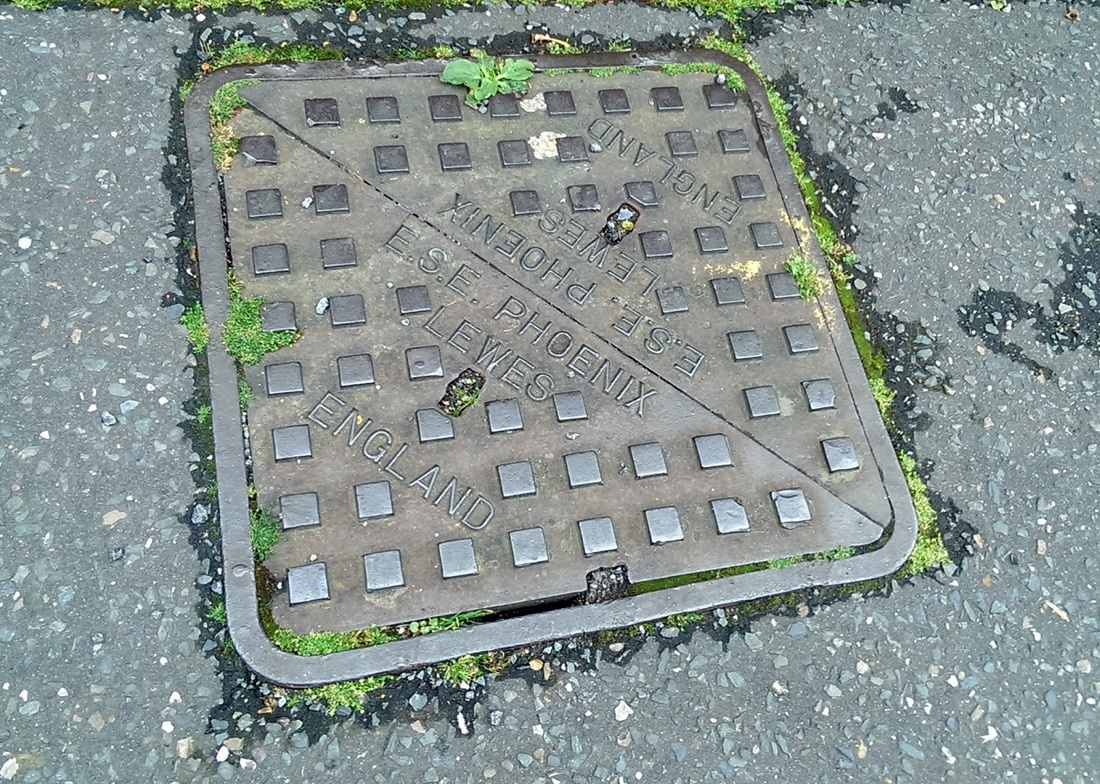
In many ways, the destruction of the theatre - from an accident involving a wood-burning stove, it was reported - appeared to catalyse local interest in the site. Back in 2012, many of the buildings had been acquired by the Santon Group and MAS for redevelopment. Their plans were shared as part of a public consultation process that started in 2013. But these plans didn't meet with everyone's approval: Lewes Phoenix Rising was set up in 2014 to propose an alternative scheme that involved renovating some of the Phoenix Ironworks buildings.
 
Earlier this year came a commission from my friends at Viva Lewes magazine. Would I be interested in writing a series or articles about the various parties involved with what was being called the 'North Street Quarter'? Definitely: it was a story I wanted to learn more about, despite my fear that dealing with rival groups could turn out to be a poisoned chalice. So, on a cold but sunny morning in March, I met Rob Blackman, the leader of Lewes District Council, and Clive Wilding of Santon.
 
They'd just revealed their proposals, which included 416 new homes, new workspaces, a health centre, additional flood defences for the town and access to the river bank. Rob was there because Lewes District Council owned around 30% of the North Street site, with the Santon/MAS partnership - now a separate company called Santon North Street - responsible for the rest. As I marvelled over the intricate wooden model of the proposed development, I looked for an opportunity to crack a joke about him doing a deal with the devil.
 
The joke didn't happen. Rob seemed genuinely concerned about trying to do the best thing for the people of Lewes. Both he and Clive gave me considerably more time than they'd scheduled. A cynic might suggest it was in their interest to do so. I think they were genuinely keen to tell their story. Well, either that or my Columbo interviewing technique was unusually effective. "Just one last thing..."
 
The following month I met Chelsea Renton of Lewes Phoenix Rising over a cup of coffee. Two cups each, by the time we'd finished talking. We were in a small cafe, so I wasn't too surprised when one of the customers joined in to defend Chelsea when she was responding passionately to a particularly provocative question of mine. Afterwards she showed me around one of the former Phoenix buildings, which housed the Foundry Gallery and several manufacturing businesses as well as her own art studio. Yes, that same cynic might suggest it was in her interest to spend time with me. I think it came from a genuine desire to promote the people who worked on the estate.
 
Just a few days after my meeting with Chelsea, Lewes Town Council (not to be confused with land-owning Lewes District Council) objected to the Santon/LDC planning application. Councillor Susan Murray, who chaired the town council’s planning committee, told me that many of their concerns were about the loss of existing employment and the affordability of housing. She also revealed that nearly all of the planning committee were supporters of Lewes Phoenix Rising. Although the town council's decision wasn't final -  that decision was being made by the South Downs National Park Authority - it would need to be considered by the SDNPA.
 
In May I was busy researching concerns about flooding. Some residents from the Pells area told me that Santon had effectively gone back on a promise. They said Santon's current planning submission showed that Pells-area flood defences wouldn't be completed until phase 3 of the development, despite earlier assurances this would happen during the first phase. After contacting Clive Wilding of Santon North Street, he responded with proposals to amend the planning application and bring forward some of the Pells flood defence work. In the Hollywood blockbuster version of my story, there'd be a headline of 'Local reporter's investigations prompt u-turn'... but I doubt that's what really happened.
 
And so, eventually, decision day arrived for application SDNP/15/01146/FUL. Thursday 10th December 2015. Because Lewes is part of the South Downs National Park, the final decision needed to be made by the South Downs National Park Authority. Such was the amount of local interest, they came to Lewes for their final meeting instead of holding it in their Midhurst headquarters. Thirteen people would be permitted to speak: some members of the public opposing the application and some supporting the application, as well as town, district and county councillors. Each would have a maximum of three minutes to make their points.
 
Even before things got started, there was a bit of a clue about the way the meeting would go: the Planning Committee had been given an 82 page document from the Park Authority's Director of Planning, recommending approval of the application subject to a number of terms, which included ensuring that 40% of homes are affordable, getting over a million pounds spent on recreation facilities and spending over £600,000 on creative workspaces. The document had been published on the SDNPA website in the week before the meeting.
 
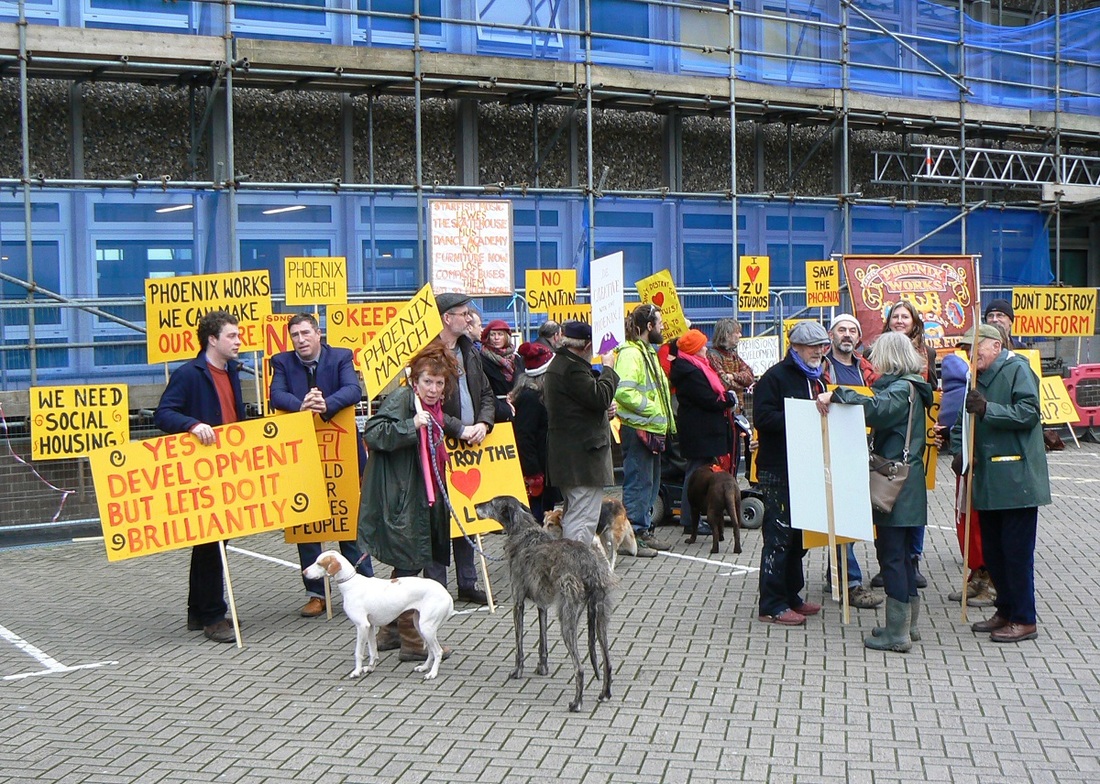
A friendly crowd of Phoenix Rising campaigners was greeting people outside as they arrived for the planning meeting. There was singing, there were placards and there were a few dogs (neither holding placards nor singing). Inside, everything ran smoothly. SDNPA case officer Stephen Cantwell presented the application before the discussions started. The only minor hiccups came when Chelsea Renton overran her allotted three-minute speaking time and John Chaplin of Lewes Tree Group insisted he would only address the committee when standing up. No protests, no shouting, just the occasional mutter, tut and sigh from both sides of the debate.
 
After four hours of presentation, questioning and discussion, the meeting was concluded. Committee chair Neville Harrison quoted Thomas Paine - 'a moderately good thing is not as good as it ought to be' - and Voltaire - 'the best can be the enemy of the good' - before asking the committee to vote on the proposal. It was, he said, "not perfect" but "pretty good". The committee agreed unanimously to approve the plans, although there are many conditions that will need to be confirmed and met before development can start.
 
Margaret Paren, who chairs the South Downs National Park Authority, said "This is a major application which our planning committee has considered in detail - listening closely to all viewpoints. We recognise that our decision won't be universally welcomed but we believe that it offers the best possible use of this brownfield site for the future of Lewes and the people who live here, including much-needed flood defences and drainage for the whole town and space for recreational facilities."
 
What next? The whole project will take around six years to finish. For the 'phase 1' part of the site, there'll be demolition in 2016 to make way for the first phase of the development. This is expected to be completed in about two years. Tenancies will end, businesses will need to move, those people who are living on the site will need to find somewhere new. I don't know what the Lewes Phoenix Rising group is going to do, although I imagine its members will be watching closely to ensure all the SDNPA's conditions are met and to see how the £1,145,000 for recreation facilities and the £640,000 for Creative Workspace provision and subsidy is spent.
 
There's also another potential site nearby that could be redeveloped soon: Waitrose and the derelict Wenban-Smith timber warehouse behind it, plus the bus station. Lewes District Council's proposed joint core strategy talks of this 'Eastgate' site being "a potential area for redevelopment with the priority being for the retention of a major foodstore and introduction of a replacement bus interchange". When I spoke to Clive Wilding in March, he told me a planning application from Waitrose was expected by the end of 2015. That timing now seems unlikely... but it may not be long before Lewes is debating another major development in the town centre.

Some enchanted evening...

1/12/2015

0 Comments

 
Picture
Robin Morley is hoping to introduce a new annual Lewes tradition. He's one of the directors of Enchanted Places, a company that can trace its roots back to the outdoor arts events he produced at Zap Productions as part of Brighton’s renowned Zap Club. Together with a partnership of other creative people, Robin is turning Grange Gardens into an ‘enchanted park’ this month. But what exactly does that mean?
 
"Southover Grange Gardens is one of the jewels of Lewes - and we plan to make it really sparkle", he tells me. Ross Ashton, fresh from transforming Durham Cathedral as part of the city’s Lumiere Festival last month, will produce a projected artwork that’ll animate the façade of Southover Grange. Sussex-based filmmaker Nick Driftwood is creating two new video works. The park’s trees and sculptures will be illuminated as well… but there’s much more to the show than beautiful visuals, as Robin explains. “For example, we're presenting 'calling birds', which is a digital mask that you put your face in. There'll be three or four of them. You say your wish for the season and the bird mimics your voice.”
 
Wishes are the overall theme for this first Lewes event, Robin says, encouraging people to reflect on the previous 12 months and their aspirations for the future. Robin’s own wishes are very much focussed on his audience. “As always, the challenge for a producer is to make it really exciting and to have those 'wow' moments. That what we're working hard to do.”
 
Although this will be the first year that Lewes has had an Enchanted Park, the concept has already proven successful elsewhere. The Enchanted Parks show that Robin developed and produced in Gateshead is currently celebrating its tenth anniversary, selling all 22,000 tickets in just 24 hours. It seems the biggest local challenge for Robin is spreading the word without giving away all his secrets. “We plan for this to be an annual event every December”, he says. “The first year is always the hardest, we know that. We expect the first week to build modestly, and then the second week to capture people's imaginations. You have to see it to understand it.”
 
Visitor numbers will be monitored carefully to ensure everyone can enjoy their visit, with people allowed to enter the park in 15 minute time-slots. It’s rather like an alternative to a Christmas pantomime, Robin tells me, suitable for families, for couples and for groups of friends. “If you went to the Theatre Royal in Brighton to see a show at Christmas, you’d sit in a seat and watch the magic unfold on the stage in front of you. If you come to Enchanted Park Lewes, you're on the stage, in the show. You're immersed in it.”
 
Tickets available from enchantedparklewes.co.uk; open from 4.30pm Wed 2 – Sun 6 and Wed 9 – Sun 13.
 
First published in Viva Lewes magazine issue 111 December 2015

0 Comments

Shelling out

1/11/2015

0 Comments

 
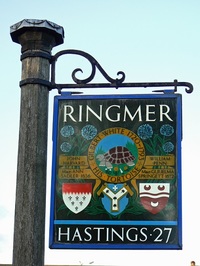
Ringmer village sign
We’re taking a look around a celebrity home for this month's Bricks and Mortar feature. Now, who would live in a place like this? It's custom-made for a single resident and was built by the original occupant. Yet despite its bespoke nature, this isn't a luxury property. Instead, it's a tiny, environmentally-sensitive place that's constructed from natural materials. What's that, you'd like a clue? Okay, our celebrity used to live in Ringmer. No, not former prime minister James Callaghan. Not singer Wendy James. It's 18th-century icon Timothy the Tortoise.
 
Timothy’s early life is something of a mystery. In fact, it was only after the tortoise’s death that anyone realised ‘he’ was actually ‘she’. It’s thought Timothy was a Greek spur-thighed tortoise (Testudo graeca) bought from a sailor in Chichester in 1740 by Henry Snooke. Mr Snooke – “one of the most rabid Tories in Sussex”, historian Jeffrey Scott Chamberlain tells us – paid half a crown (12½p) and took Timothy back to his home in Delves House, next to the church in Ringmer. There he quickly lost interest, with wife Rebecca caring for the creature.
 
The life of this tortoise would have gone unreported were it not for naturalist Gilbert White, Rebecca’s nephew. He was fascinated by his aunt’s pet and wrote reports about Timothy whenever he visited, creating what’s probably the first natural history study of a tortoise. Timothy feasted on kidney beans and cucumbers, survived flood and frost, and buried herself in the garden to hibernate each winter. When Mrs Snooke died in 1780 (apparently she’s interred below Ringmer’s parish church in the same grave as her husband), Gilbert White became Timothy’s new owner. He dug Timothy out of the hollow she was hibernating in – “it resented the insult by hissing”, he notes – and took her in a horse-drawn carriage to his home in Selborne. There he continued to observe Timothy, whose later years are documented in detail as part of White’s renowned book The Natural History and Antiquities of Selborne. Indeed, Timothy is such a major character that novelist Sylvia Townsend Warner later compiled all the tortoise-related mentions and published them in a short book entitled The Portrait of a Tortoise. More recently, Verlyn Klinkenborg turned these into a fictionalised tortoise-eye view that’s published as Timothy; or, Notes of an Abject Reptile.
 
Gilbert White died in 1793. Timothy died a year later in the spring of 1794; her age was probably around 60, based on White’s notes. But this isn’t the end of the story. Not only does Timothy live on in print, her shell was presented to the Natural History Museum by Gilbert White's great-niece in April 1853. Meanwhile, Timothy’s importance is immortalised locally in Ringmer’s village sign and also on the badge for the local primary school. That’s an impressive legacy for a 12½p pet.

First published in Viva Lewes magazine issue 110 November 2015

0 Comments
<<Previous
Forward>>

    Recent work

    Examples of my published work, with the most recent shown first. (Any links via Amazon may earn me commission on any purchases.) 

    Archives

    February 2020
    August 2019
    June 2019
    May 2019
    April 2019
    January 2019
    November 2018
    September 2018
    June 2018
    May 2018
    April 2018
    November 2017
    September 2017
    April 2017
    March 2017
    December 2016
    October 2016
    September 2016
    June 2016
    May 2016
    April 2016
    March 2016
    February 2016
    January 2016
    December 2015
    November 2015
    October 2015
    September 2015
    August 2015
    July 2015
    June 2015
    May 2015
    April 2015
    March 2015
    February 2015
    January 2015
    December 2014
    November 2014
    October 2014
    September 2014
    August 2014
    July 2014
    June 2014
    May 2014
    April 2014
    March 2014
    February 2014
    January 2014
    November 2013
    October 2013

    Categories

    All
    Art
    Comedy
    Interview
    Journalism
    Lewes
    Music
    Technology

    RSS Feed

Powered by Create your own unique website with customizable templates.